Your Hips Were Designed for This
Understanding How Hip Function Drives Your Whole Body
A foundation for stability, movement, and recovery built on how the body was actually made to work
Pastor Kevin Cicchino
Category: Wellness Foundations · Movement Basics
Tags: Hip Function, Pelvic Stability, Human Movement, Posture, Mobility, Stability, Recovery, Kinesiology, Movement Basics, Workshop Resources, Whole Person Wellness
Before we talk about exercises, stretches, or corrective programs — we need to talk about design.
Your body was not assembled randomly. It was designed with an extraordinary degree of intelligence built into every joint, every muscle group, every connective pathway. And when we work with that design rather than around it, the results are different from anything most people have experienced in a conventional fitness or rehabilitation setting.
This article is not about giving you a list of things to do. It is about giving you a foundation — a way of understanding how your body actually works — so that everything you do after this makes more sense, lands more deeply, and produces more lasting change.
That foundation begins with the hips.
What the Hip Joint Actually Is
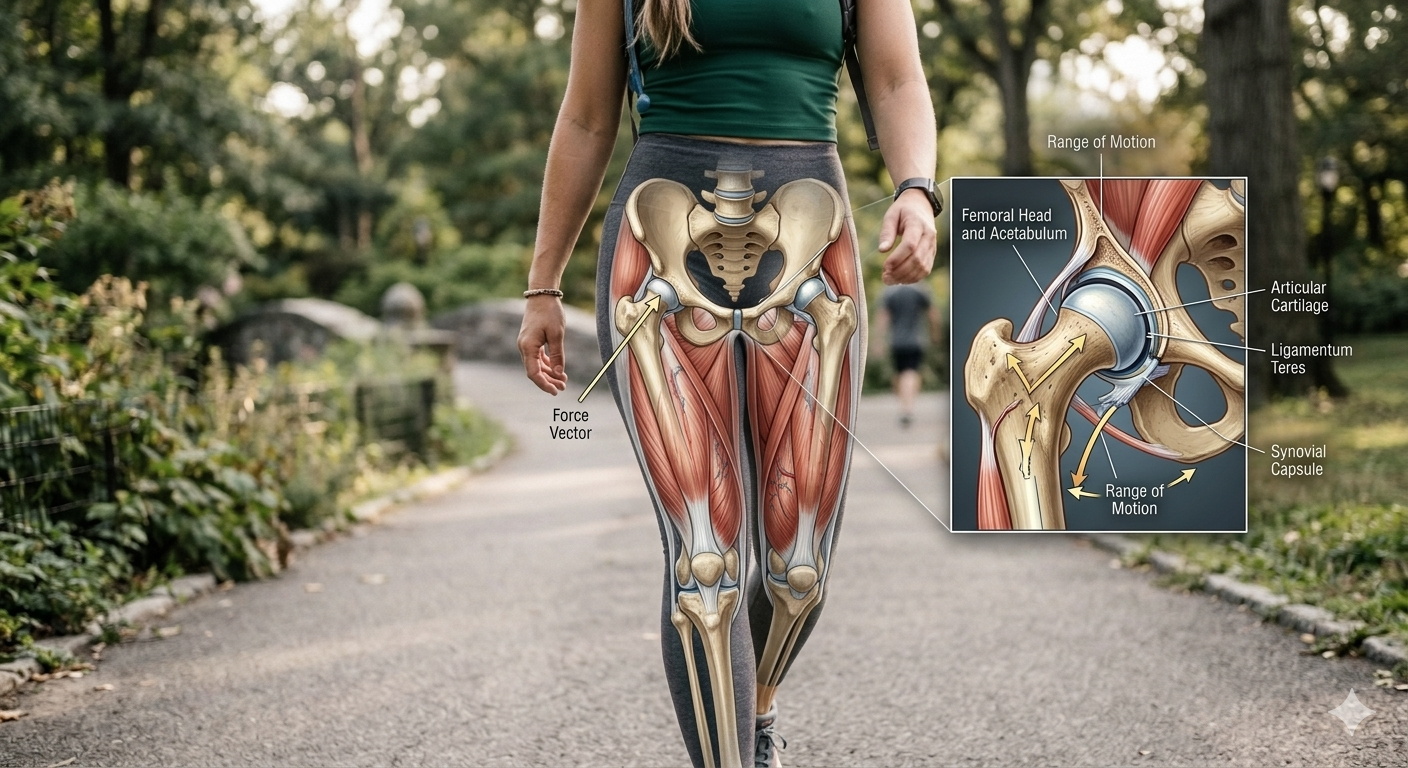
The hip is a ball-and-socket joint — the head of the femur sitting inside the acetabulum (see figure 1) of the pelvis. But describing it mechanically misses what makes it remarkable.
The hip is not just a hinge that allows your leg to move. It is the primary load transfer point for your entire body. Everything above it — your spine, your ribcage, your shoulders, your neck — and everything below it — your knees, your ankles, your feet — communicates through the hip and pelvic girdle.
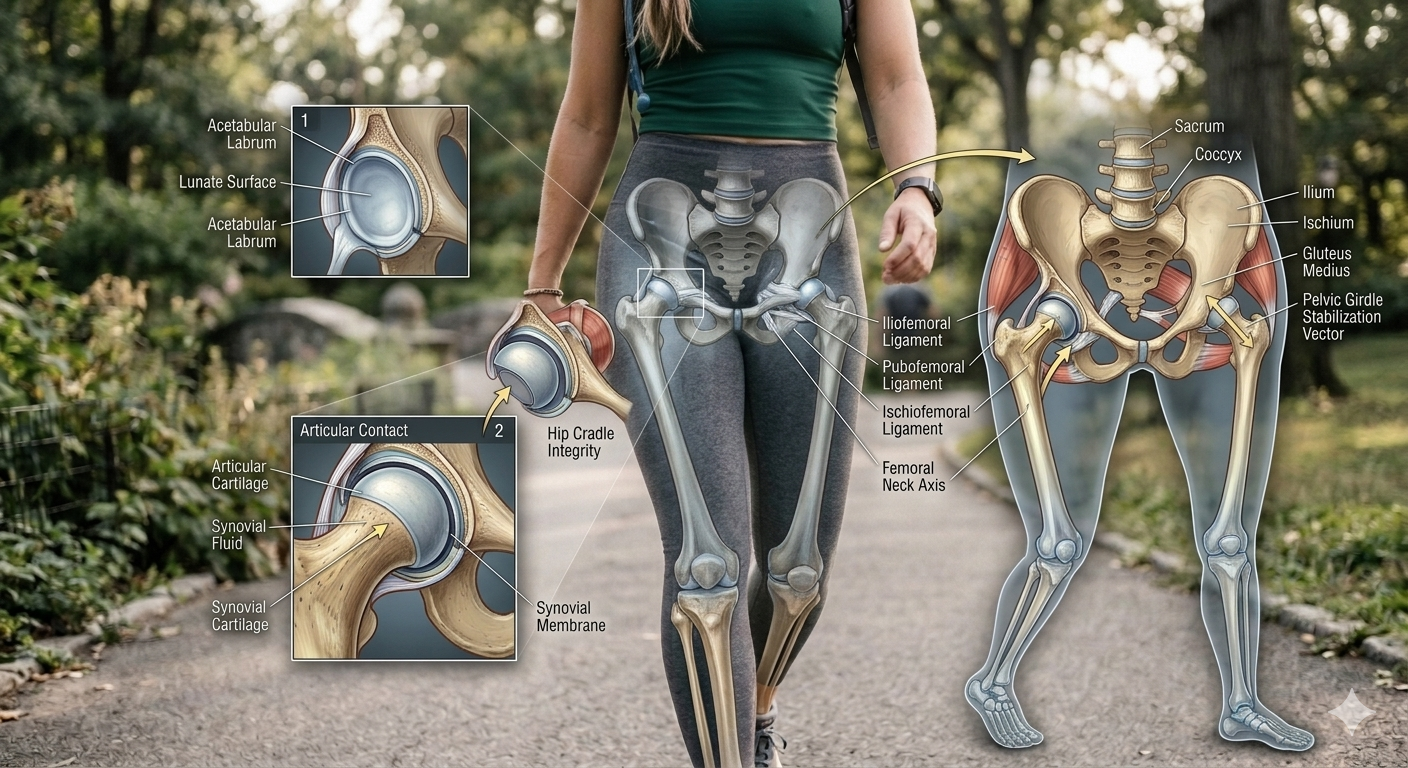
When the hip is functioning well, load moves through it efficiently. The nervous system distributes force across the structures designed to handle it. Movement flows — not perfectly, but fluidly enough that the body can do what it needs to do without excessive compensation elsewhere.
When the hip is not functioning well — when there is instability, immobility, or left-right asymmetry — the body doesn't stop. It adapts. It finds another way. And those adaptations, repeated thousands of times a day in every step you take, in every time you sit and stand, in every load you carry — become the source of pain, dysfunction, and limitation that most people spend years trying to address in the wrong place.
The Pelvic Girdle — The Command Center
The pelvis is not simply the structure your hip joints attach to. It is the command center for postural stability throughout your entire body.
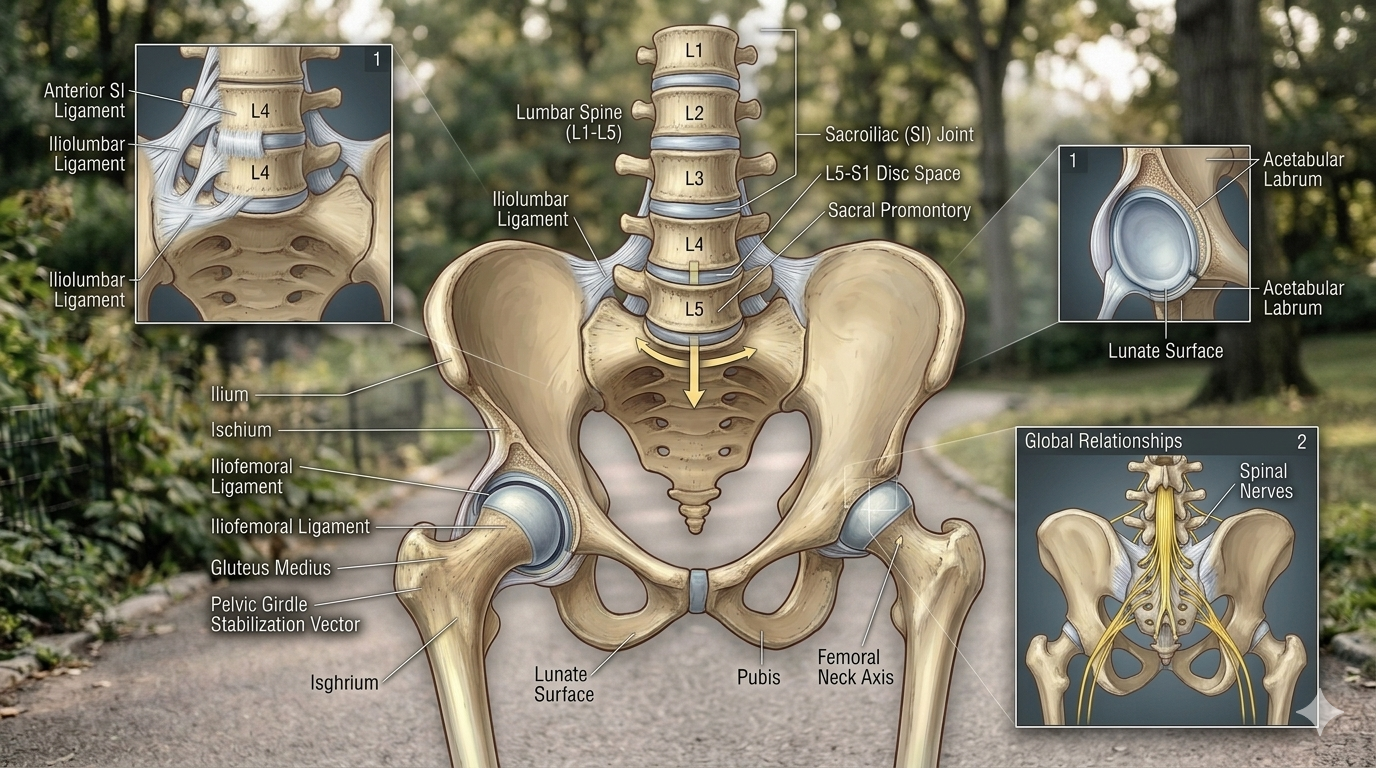
The pelvis connects the spine above to the lower extremities below. It houses the attachments for the most powerful muscles in the human body — the gluteus maximus, the hamstrings, the hip flexors, the deep hip rotators. And it has a relationship with the diaphragm above it that most movement programs never address.
Here is something worth sitting with:
Your ability to breathe properly and your pelvic stability are directly connected.
The diaphragm — your primary breathing muscle — and the pelvic floor function as a pressure system together. When that system is working well, intra-abdominal pressure is managed efficiently and the spine and pelvis are stabilized from the inside out during movement. When it is not working well — when breathing patterns are shallow, when the pelvic floor is either too tight or too weak, when the diaphragm is not used fully — the body loses its primary internal stabilization system and begins compensating through the surrounding muscles and joints.
This is often where chronic low back tension, hip tightness, and SI joint discomfort begin. Not in the back. Not in the hip. In the pressure system that was designed to stabilize both.
Left and Right — The Synchronicity Problem
One of the most common presentations we see is left-right asymmetry in the hips — one side that moves differently, loads differently, or feels different from the other.
Most people assume the solution is to work on the side that hurts or feels weak. But the body is a closed-loop system. What appears as a problem on one side is almost always a reflection of what is happening on the other.
Think of it this way — if you have a conversation between two people and one of them stops speaking clearly, the other one has to compensate to keep the communication going. The one doing extra work is not the problem. The breakdown in communication is the problem.
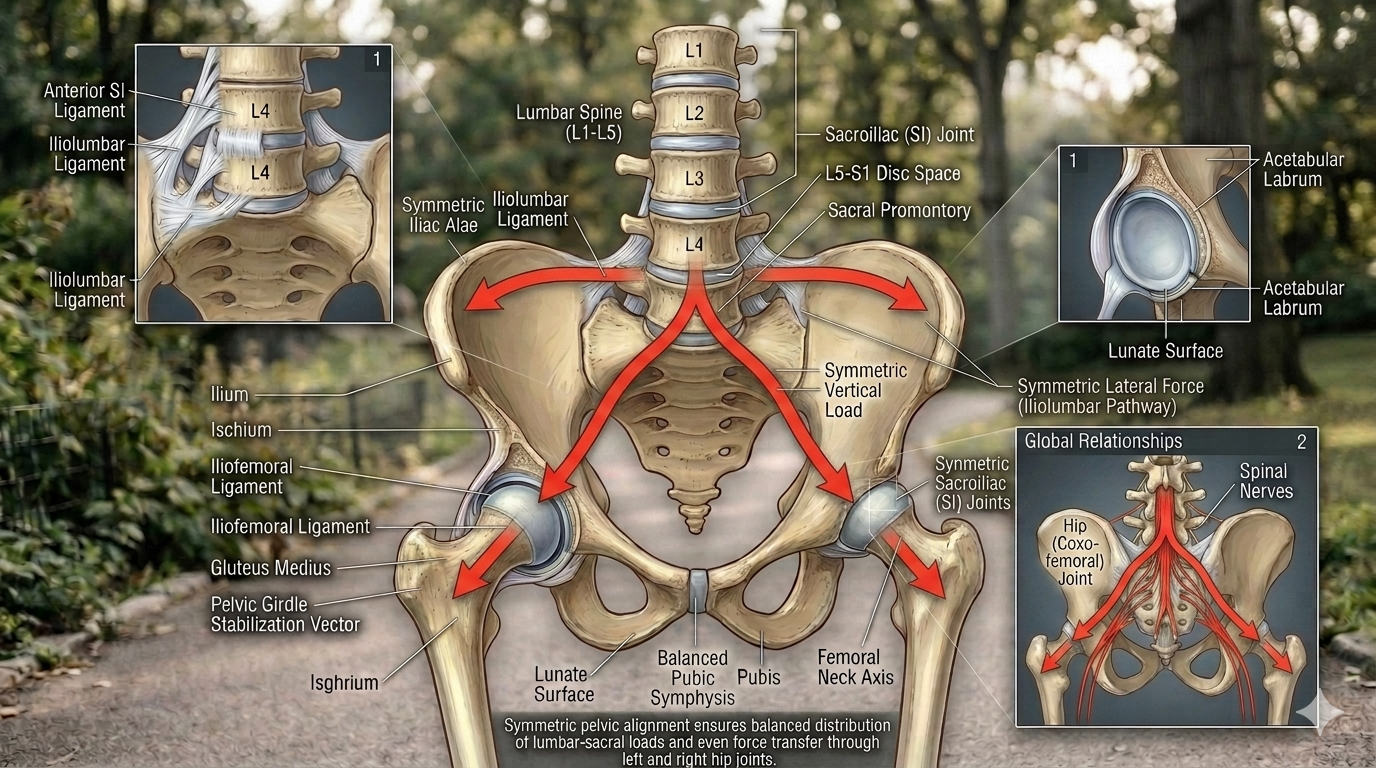
Left-right instability in the hips shows up as:
Uneven loading through the knees and feet
One shoulder sitting higher than the other
Rotation through the spine that accommodates the asymmetry
Pain that moves — from hip to knee to back to neck — because the compensation pattern shifts depending on the demand
We are not fixing a side. We are restoring the conversation between both halves of the body.
The Muscles of the Hip — What They Actually Do
The hip is surrounded by some of the most powerful and functionally important muscles in the body. Understanding what they are designed to do — and how they are often prevented from doing it — is foundational to everything that follows.
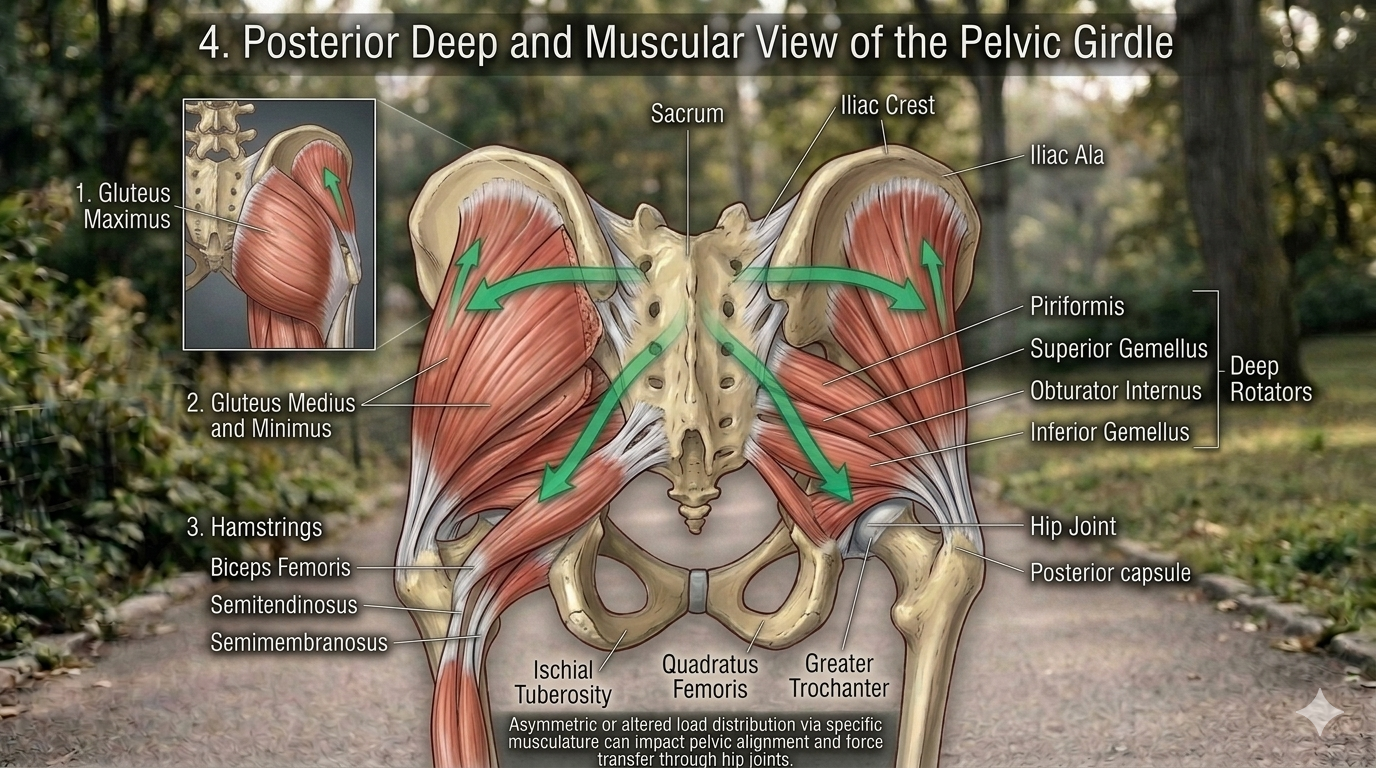
The Gluteus Maximus The largest muscle in the body. Designed to be the primary driver of hip extension — the movement that propels you forward in walking, running, climbing, and rising from a seated position. In most people it is chronically underactivated — not because it is weak in isolation, but because the neurological connection between the hip girdle and the muscle has been disrupted by compensated movement patterns.
The Hamstrings Often described as the muscles on the back of the thigh. But their true function is deeply connected to the hip — they assist in hip extension and play a critical role in controlling the pelvis during movement. The hamstrings gain their true neurological ability through the hip girdle connection. Without that connection, they pull rather than coordinate — and that pulling is often the source of the chronic tightness people try to stretch away without ever addressing the root.
The Hip Abductors — Gluteus Medius and Minimus Located on the outer hip, these muscles are the primary stabilizers of the pelvis during single-leg activities — every step you take is a single-leg activity. When they are not functioning well, the pelvis drops on the unsupported side during gait, creating a cascade of compensations through the knee, ankle, and spine.
The Deep Hip Rotators — Including the Piriformis These small but critical muscles control the rotation of the femur in the acetabulum. When the hip girdle is not providing adequate stability, the nervous system loads tension into these muscles as a secondary stabilization strategy. This is where piriformis syndrome, sciatic-like symptoms, and deep hip pain often originate — not from a problem with the piriformis itself, but from the system asking it to do a job it was not designed to do.
The Shoulder Connection Most People Miss
Here is something that surprises most people: the shoulder girdle and the hip girdle are functionally linked in ways that directly affect hip stability, strength, and mobility.
The body moves in diagonal patterns — cross-body, contralateral connections that link the left shoulder to the right hip and the right shoulder to the left hip. These connections run through the deep fascial system¹ and through the neurological coordination patterns that govern how you walk, run, rotate, and transfer force.
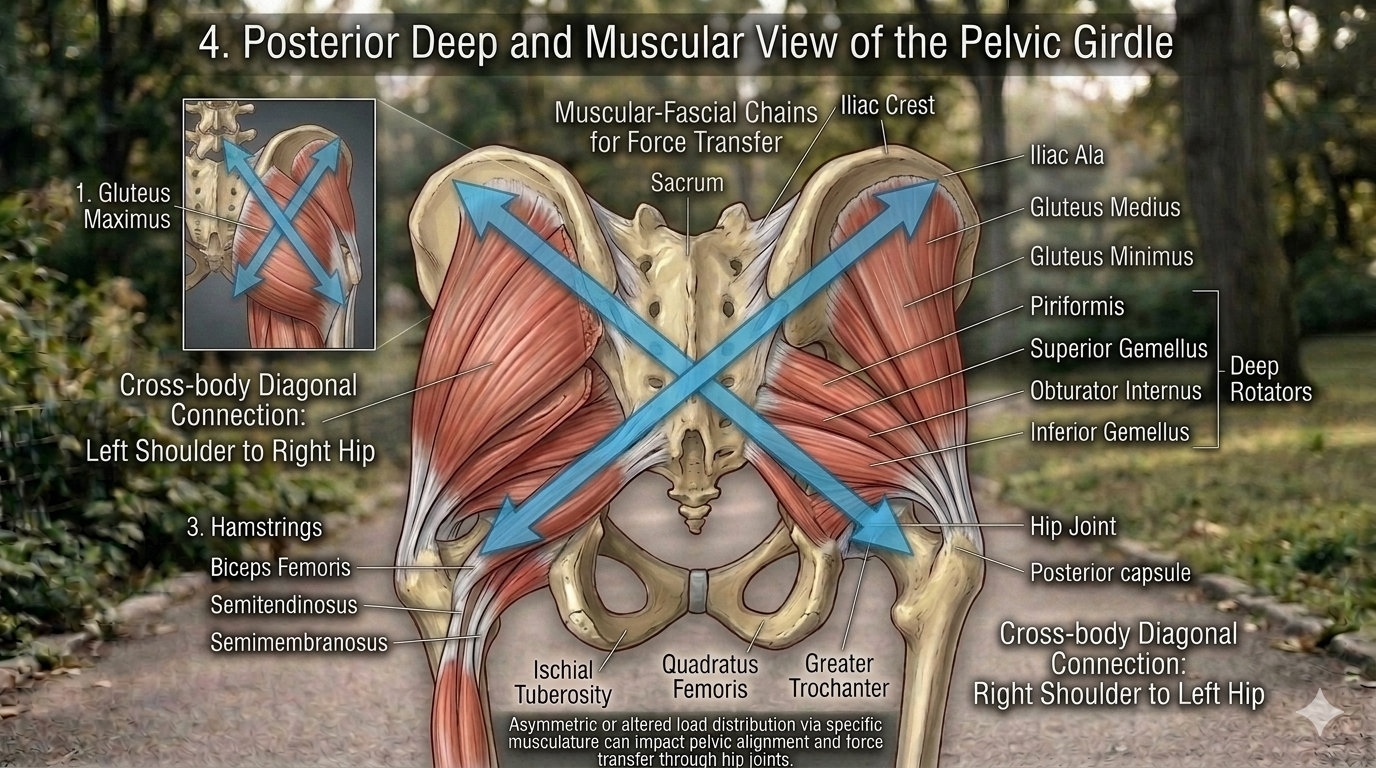
When there is restriction or dysfunction in the shoulder girdle — limited thoracic rotation, elevated tension through the upper traps and neck, poor scapular stability — it directly affects the hip on the opposite side. And the reverse is equally true.
This is why addressing hip instability in isolation frequently produces incomplete results. The conversation the body is having crosses the midline, moves through multiple joints, and cannot be resolved by focusing on a single location
Postural Alignment — A Dynamic Process
Posture is not a position you hold. It is a continuous negotiation between your nervous system and gravity.
Most people approach posture as a static correction — stand up straight, pull your shoulders back, tuck your pelvis. These instructions address the surface expression of a postural pattern without touching the dynamic system that produces it.
Your nervous system is constantly reading information from your joints, your muscles, your vestibular system, and your vision — and making real-time adjustments to keep you upright and functional. When that system has good information to work with — when the hip girdle is stable, when the diaphragm and pelvic floor are coordinating, when the left-right conversation is balanced — posture is an expression of efficient design.
When the system has poor information — when compensations have accumulated, when certain muscles have gone offline, when the body is working around rather than through its design — posture becomes an expression of those accumulated adaptations.
We are not teaching you to stand differently. We are restoring the conditions under which your nervous system can organize efficient posture on its own.
What This Means Before You Ever Do an Exercise
Everything described above — the hip girdle as load transfer center, the diaphragm-pelvis pressure system, the left-right synchronicity conversation, the shoulder-hip diagonal connection — is the foundation that makes movement instruction meaningful.
Without it, exercises are recipes. With it, they are education.
When you understand that the tightness you feel in your hip is the nervous system protecting an area it perceives as unstable — you stop fighting the tightness and start addressing the instability.
When you understand that the knee pain you experience going down stairs is a left-right loading asymmetry expressing itself at the knee — you stop treating the knee and start restoring the conversation.
When you understand that the chronic tension in your upper back and neck has a direct relationship with what is happening in your hip girdle and diaphragm — you stop trying to stretch your way out of the neck and start addressing the system.
This is the shift from instruction to education. From recipe to chemistry. From working on a part to tuning the instrument.
A Word About What You May Have Been Told
Over the years we have worked with people who came in carrying years of accumulated information — from doctors, physical therapists, trainers, friends, and the internet. Some of that information was accurate. Some of it was not. Most of it was true in isolation but incomplete in application — a good brick with no mortar.
We are not here to dismiss what you have learned. We are here to show you where it fits inside a larger system — one that was designed before any of us arrived and that functions according to principles that do not change regardless of what is trending.
If something you have read or been told conflicts with what you find here — hold both. Ask the question. Because the truth about how the body works does not require you to abandon what you know. It requires you to see it in its proper context.
Effort. Preparedness. Ability.
Whatever work follows this foundation — whatever exercises, whatever programs, whatever stages of rehabilitation or strengthening — these three things are always what is being trained.
Effort — the quality of engagement you bring to the movement. Not intensity for its own sake, but genuine connection between your intention and your body's response.
Preparedness — the condition your body is in to receive and respond to the demand being placed on it. This changes day to day, session to session. A good system accounts for that variation rather than ignoring it.
Ability — the capacity that develops over time through consistent, connected, progressive engagement. Not a fixed ceiling. A growing edge.
These three are always present. Always being developed. Always providing feedback. When something isn't working — when progress stalls, when discomfort appears, when the body resists — the answer is always found in one of these three places.
A Prayer for What Comes Next
Before you move into the practical work — we want to offer something that may seem unexpected in a wellness article.
The body stores more than movement patterns. It stores the experiences, the frustrations, the failures, and the fears that have accumulated over a lifetime of living in it. Many people carry tension not just from how they have moved but from what they have been through. Those things are real. They live in the tissue. They affect the nervous system. They shape the compensations we carry.
We have seen people make physical changes in a single session that years of conventional treatment had not produced — not because they found the right exercise, but because something released. They stopped believing a lie about their body. They invested in themselves. They received what they had been looking for.
We believe that is more than physiology — though it is that too.
Holy Spirit, we ask that You minister to every person reading this — in their body, in their nervous system, in the places where tension has been stored that has nothing to do with movement and everything to do with life. Lord, where the body has been compensating for pain that was never physical, we ask for release. Where there has been disconnection — from the body, from hope, from the expectation of change — we ask for restoration. We pray that as these foundations are understood and applied, the whole person experiences the freedom they were designed for. In Jesus name. Amen.
Expect that something is already shifting. The understanding itself is part of the process.
What Comes Next
This Foundation article is the beginning. The work that follows it is built on what you now understand.
In our next piece we move into practical application — a specific exercise sequence that puts this foundation into motion, teaching your body to find stability, restore the left-right conversation, and begin building the kind of strength that lasts.
Next: Exercise # 1-For Uneven Hips
Connected Resources
Are You Actually Moving — or Just Being Moved?
Does It Matter Whether Movement Is Active or Passive?
Footnotes / Reference Glossary
¹ Fascial System — The network of connective tissue that surrounds and connects every muscle, bone, organ, and nerve in the body. Functions as a continuous tensional web that transmits force and communicates information throughout the body — not just locally at the site of movement or pain.
This article is for educational and informational purposes only. The content presented here is not intended to diagnose, treat, cure, or prevent any condition or disease. Nothing in this article should be taken as medical advice. Before beginning any new movement practice, exercise program, or physical activity — particularly if you have a current or prior injury, chronic condition, or have been advised by a healthcare provider — please consult your physician or a qualified healthcare professional. The exercises and educational content shared here are general in nature and may not be appropriate for every individual. Always listen to your body and seek professional guidance when needed.