Are You Actually Moving
or Just Being Moved?
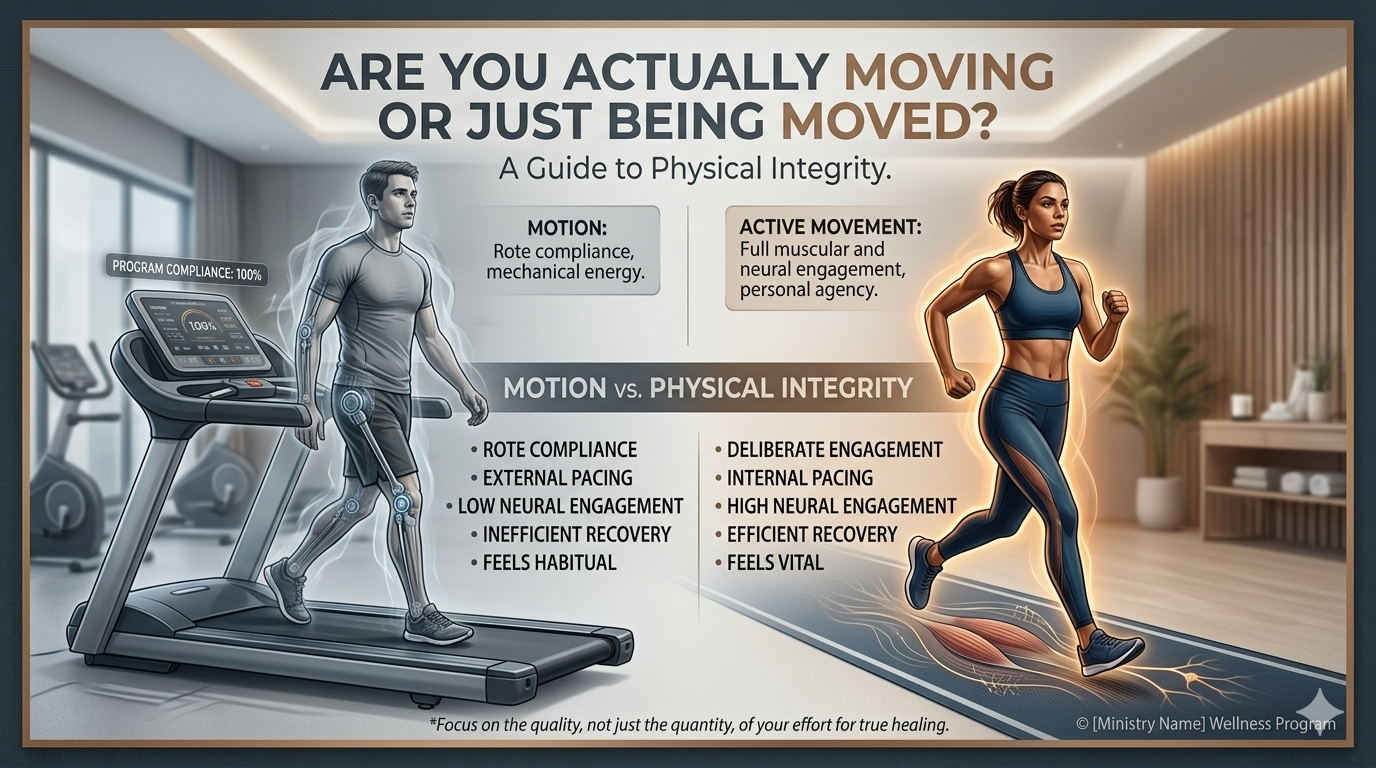
"Motion is a physical event; movement is a neurological decision."
Pastor Kevin Cicchino
Category: Foundations
Tags: human movement, active movement, mind-body connection, training principles, kinesiology, physical wellness, body awareness, neuromuscular control, workshop resources, health foundations
Most people who exercise regularly believe they are doing active movement.
They show up. They lift the weights. They run the miles. They follow the program. And from the outside, it looks exactly like active movement — because the body is in motion.
But motion and active movement are not the same thing.
And that distinction — once you understand it — changes everything about how you train, how you recover, and how you relate to your own body.
The Misunderstanding Nobody Talks About
Here is what most people are actually doing when they exercise:
They are being moved.
The weight tells them how far to go. The machine guides the path. The momentum of the previous rep carries them into the next one. The equipment sets the range, the angle, the load — and the body follows along, largely as a passenger.
This isn't a character flaw. It's a result of how most people have been taught to think about training.
The common understanding goes something like this: the equipment, the program, or the process is what trains the body.You pick the right weights, follow the right routine, use the right machine — and the body improves as a result.
But that framing has it backwards.
The equipment doesn't train the body. The body trains the body. The weights, the resistance, the apparatus — these are simply the context. They are the environment the body works within. What actually produces change is the body's own effort, intention, and neuromuscular engagement¹ with that environment.
When people forget that — or were never taught it — they outsource the movement to the tool. And the body, which is remarkably good at finding the path of least resistance, lets it happen.
What Active Movement Actually Means
True active movement is not defined by what the body is doing on the outside.
It is defined by what is happening on the inside — specifically, whether the muscles, joints, and nervous system² are engaged as the primary decision-makers of the movement.
In active movement:
The muscles initiate and control the motion — they don't just react to it
The joints move through ranges they own, not ranges the equipment pushes them through
The nervous system² is communicating continuously — registering feedback, making adjustments, coordinating the whole
The mind is present in the movement — not managing it from a distance, but genuinely connected to what the body is doing and why
This is not about moving slowly or thinking too hard. Elite athletes move fast, powerfully, and fluidly — and they are deeply connected to every inch of what their body is doing. That connection is part of what makes them elite.
Active movement is ownership of motion. The tool is in your hands. You are not in the tool's.
The Weight Doesn't Know What You Need
Here is a simple example that makes this concrete.
Two people perform the same bicep curl with the same weight.
The first person grips the bar, swings it up using momentum from their lower back, lets it drop on the way down, and repeats. The weight moves. The rep gets counted. The set gets done.
The second person grips the bar with intention, feels the muscle engage before the movement begins, controls the full path up and down, and consciously resists at the bottom rather than letting the weight fall. The weight moves the same distance. The rep looks similar from across the room.
But what happened inside those two bodies is completely different.
The first person was moved by the weight. The second person moved with the weight — using it as resistance against their own deliberate muscular output.
Over time, those two approaches produce different bodies, different levels of joint health, different injury risk, and a fundamentally different relationship between the person and their own physical capability.
Conditioning Has Conditioned Us
The reason this misunderstanding is so widespread is that much of how fitness and training has been packaged and sold focuses on the external — the program, the equipment, the protocol.
Follow this plan. Use this machine. Do these sets and reps.
All of that has value. Structure matters. Progressive resistance³ matters. Good programming matters.
But when the emphasis is entirely on the external framework, people learn to follow the process rather than develop the internal connection. They become dependent on the apparatus to tell them what to do, how far to go, and when they've done enough.
The body stops being trained. It starts being operated.
And an operated body is not the same as a trained one. A trained body has internalized the patterns. It has developed neuromuscular control¹, proprioception⁴, and the ability to generate and regulate force from the inside out. An operated body has learned to function within a machine — and often struggles the moment the machine is removed.
This Doesn't Make Passive Movement the Enemy
Understanding true active movement doesn't eliminate the role of passive movement or passive therapy. In fact, it clarifies it.
There are times when the body genuinely needs skilled external input — when a joint has lost mobility, when tissue is restricted, when pain has altered movement patterns and the nervous system² needs a reset before it can engage properly again. In those moments, manual therapy⁵, joint mobilization⁶, and other passive interventions are not bypassing the body's ownership of movement. They are restoring the conditions under which the body can own its movement again.
Passive recovery — rest, soft tissue work, mobilization — is not laziness. It is preparation. It is maintenance. And in many cases, it is what makes real active movement possible.
The goal is always to move the person back toward full, connected, intentional movement. Passive work serves active movement. It doesn't replace it.
A Question Worth Sitting With
The next time you train — or the next time you move through any physical activity — ask yourself honestly:
Am I moving, or am I being moved?
Is your body engaged and in control of what's happening, or is the equipment, the momentum, or the habit doing the work while you watch from inside?
That question, taken seriously over time, will change how you train more than any program ever could.
Because the body was designed to move — not to be operated. And when it learns to own its movement again, everything changes: strength, stability, recovery, injury resistance, and the simple experience of being at home in your own physical life.
Connected Resources
To understand the research behind passive movement and manual therapy — and why both have a legitimate place in your recovery and training — read our study:
Does It Matter Whether Movement Is Active or Passive?
Footnotes / Reference Glossary
¹ Neuromuscular Engagement / Neuromuscular Control — The communication between the nervous system and the muscles that allows the body to initiate, coordinate, and regulate movement. When this connection is active and intentional, movement is more efficient, safer, and more effective.
² Nervous System — The network of the brain, spinal cord, and nerves that controls all movement and sensation in the body. In the context of movement, it is responsible for sending signals that activate muscles, receive feedback from joints and tissues, and make real-time adjustments during activity.
³ Progressive Resistance — A training principle where the demand placed on the body is gradually increased over time — through added weight, reps, speed, or complexity — to continue producing adaptation and improvement.
⁴ Proprioception — The body's ability to sense its own position, movement, and balance in space without relying on vision. Often called the "sixth sense" of the body. Strong proprioception means the body knows where it is and what it's doing at all times — a key component of injury prevention and movement quality.
⁵ Manual Therapy — Hands-on treatment performed by a trained therapist to reduce pain, restore joint mobility, and improve tissue function. Includes techniques like joint mobilization, manipulation, and soft tissue work.
⁶ Joint Mobilization — A manual therapy technique involving gentle, controlled movement applied to a joint to reduce stiffness, restore range of motion, and decrease pain.
This article is for educational purposes. It is not intended as personal medical advice. If you are dealing with pain, injury, or movement limitations, please consult a qualified healthcare provider.