America at 250: The Church's Declaration of Dependence
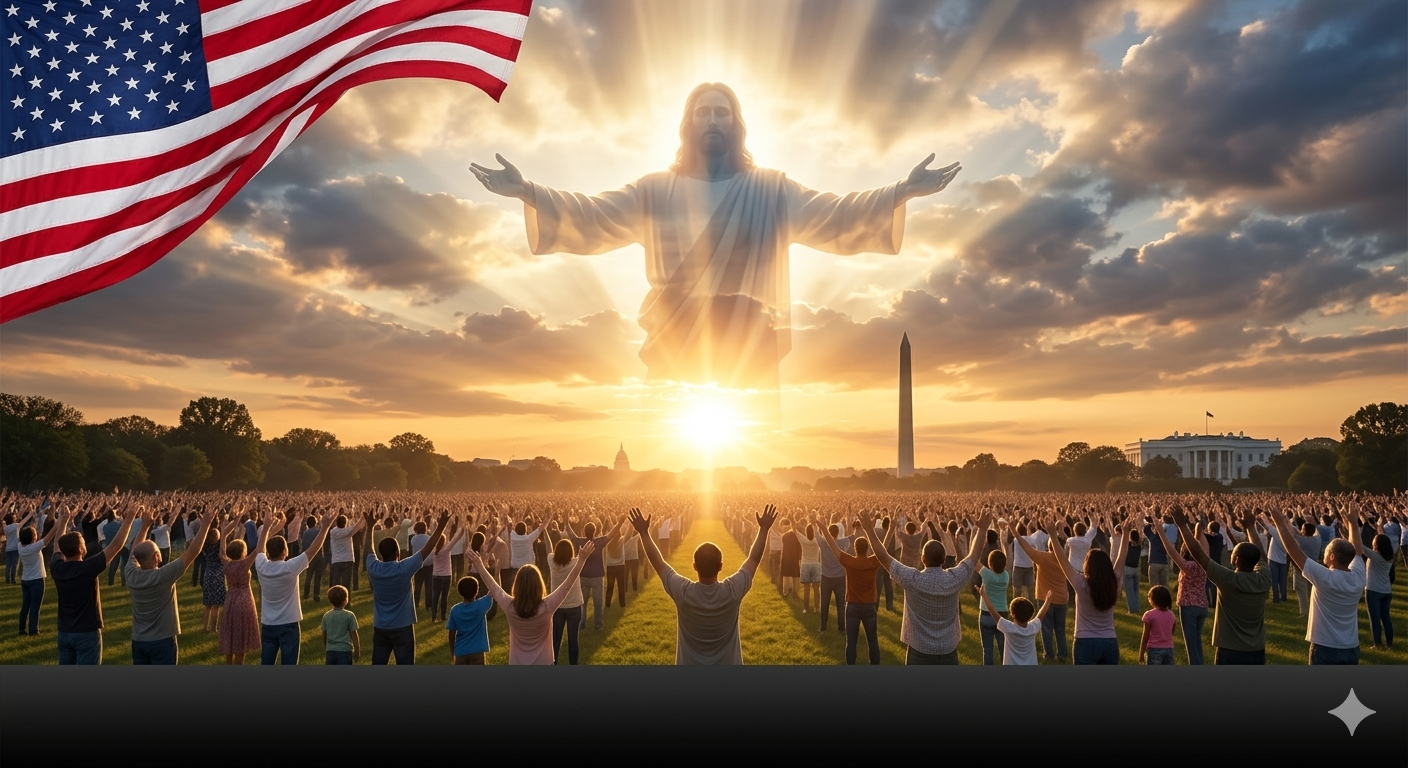
Pastor Kevin Cicchino
Category: Theology And Christian Living
Tags: Revival, America, Declaration of Independence, Faith, Prayer, Kingdom of God, Church, Nation, Grace, Dependence on God, Spiritual Renewal, Christianity and Culture, Biblical Foundations
America at 250: The Church's Declaration of Dependence
July 5, 2026
Pastor Kevin Cicchino
Today Americans conntinue celebrating the 250th anniversary of our Declaration of Political Independence from the British Empire. But there is another declaration underneath that one, and almost no one is preaching it. Strip away the flags and the fireworks for a moment, and look at what our founders actually wrote, what our leaders are actually rediscovering, and what our history has actually done — and you will find something that was never merely political at all. You will find the outline of how God governs a people. Not a metaphor for it. The outline of it.
Here is the one principle that makes sense of this moment: every law, every pattern, every hard-won recovery this nation is celebrating right now has an exact and older twin in how God has always governed His own. What Washington did at Valley Forge, what Lincoln did for the producer and the laborer, what a nation of tariffs and factories once knew and then lost for 125 years and is only now recovering — all of it is a shadow. The substance was always the Kingdom. And once you see the shadow clearly, you cannot unsee the substance behind it.
Start with the question of who leads. God does not set a king over a people because of the man's accomplishments, nor does He remove one only because of his failures. He sets leadership according to willingness and purpose within His own plan — even when that plan makes no earthly sense (Isaiah 55:8-9). Daniel said it plainly: God removes kings and sets up kings (Daniel 2:21). That has never changed, and it is not changing now. The mistake most people make when watching any presidency is grading it like a performance review. God is not grading a performance review. He is positioning a willing vessel inside a purpose that will only make sense later.
Now go one layer deeper, because this is where it gets easy to miss. There is a difference between religion and living faith. Religion, as our founders framed it in the First Amendment, is the freedom for a society to worship whom it chooses. That freedom is good, but freedom alone does not transform anything. It simply makes room — a place for every person to bring whatever faith they carry. But the country was never designed to end there. It was designed under the belief that Jesus is the way, and the room it makes is room to grow into that, not room to stay wherever a person started.
That is the actual job description for the believer within this arrangement: to be salt and light (Matthew 5:13-14), to be the example that a harvest field is ripe for, because the fields are white and waiting (John 4:35). Something greater than the temple is here (Matthew 12:6) — a new covenant, a kingdom already at work alongside the Messiah — and a nation's whole purpose, church and state standing side by side rather than merged into one, was to give that kingdom a visible place to be seen: seen in the fruit, seen in the light, seen in a people set apart, so that others are drawn toward righteousness rather than commanded into it.
And here is the quiet miracle beneath that arrangement: even people who have not yet chosen to believe still live within the blessing produced by those who have. That is not sentiment; it is Scripture — through Abraham's line, all the families of the earth would be blessed (Genesis 12:3). This is what "one nation under God" was actually describing. Not that everyone in the nation believes. Rather, the fruit of those who do becomes the very place where those who don't yet believe are given room to see it, taste it, and be drawn toward receiving Christ themselves.
Which means the responsibility was never ours to judge the ones still growing. It was ours to judge ourselves — to be the appropriate example, so grace has room to work through us instead of judgment. Hearts open by what they see, not only by what they're told, and many come to faith that way. And the ones who believe in some fashion but haven't yet given themselves over as a whole are not condemned for it. That is exactly where grace and mercy meet — while we were still sinners, Christ died for us (Romans 5:8). That mercy is not a loophole. It is the governing mechanism underneath everything this nation was ever supposed to model.
Let's now incorporate the economic perspective, as this is where the founding fathers and mystics of previous generations, often unknowingly, convey the same message. The American System, as revived, asserts that a nation's true measure isn't just what's exchanged at the checkout counter but what is produced at the factory gate—what is actually created, not merely consumed. This principle isn't just economic; it's spiritual. Scripture describes it through sowing and reaping: what a man sows, he will also reap (Galatians 6:7-9). A branch that remains connected bears fruit; a disconnected one withers (John 15). Grace was never meant to be merely received at the checkout on a Sunday morning and then left. Instead, grace is meant to be cultivated—within our lives, families, and nations—much like tariffs were designed to protect factories long enough for them to produce. A life of grace that only takes and never gives is just consumption masquerading as faith. The true economy of the Kingdom is a life of grace that bears fruit.
I want to be careful here, because this is not simply hunting for a few verses that sound convenient. Read the whole of Scripture, Genesis to Revelation, the way you'd read a concordance rather than a highlight reel, and you find one consistent shape: a God who does not change, who governs by grace, and who ordained order not as a formula but as protection for the people He loves. He is not a system. He is not a mechanism. He is a Person who sets laws in place the way a father child-proofs a home — not to confine, but to keep alive what He loves.
The true adversary was never a person—neither Pharaoh, George III, nor any president or party. Instead, a spiritual force has always worked to distort and replace God's order (Ephesians 6:12). This has occurred in Egypt, which refused to surrender its captives; at Babel, where people sought unity through pride rather than God, leading to their dispersion (Genesis 11); and in 1901, when President McKinley, who understood a producer's economy, was assassinated, and that knowledge was kept hidden for 125 years. Today, this same enemy spirit—opposite to God's Spirit—adapts to a modern disguise. It manifests subtly through culturalism, pluralism, the proliferation of identities claiming sovereignty, and a virtual existence replacing real, physical life. It does not openly deny God's sovereignty but subtly multiplies competing sovereignties, fragmenting authority until no part of God's nature is honored. Ultimately, what remains is fragmentation, and this division, rather than elections or policies, fuels the ongoing civil war among people.
And here is the part we don't want to face: no one actually escapes being subject to something. Every man serves a sovereignty of some kind — the only real question was ever going to be whose (Joshua 24:15, Romans 6:16). Reject God's, and you are not left free of a master. You are simply handed a new one. That is exactly what a colonial order of things — a British system, or whatever wears its clothes in a given century — has always done to the American system God helped build: not conquer it outright, but quietly re-enslave it, make it captive to Egypt all over again, dressed up as progress. And if we are not careful, eyes wide open, we will blink and find ourselves carried right back out from under the very protection God was giving us to keep the enemy's power from ever growing strong in our lives again.
None of this is new, and that matters. Seeing a timeline doesn't mean inventing it; it means recognizing an ongoing pattern rooted in the same problem, repeated across generations. What may be unique now is that an entire generation, alive at the same time, has gathered enough evidence in one place to realize how far they've deviated from God's order — and to choose collectively to turn back. This is why, read correctly, the Declaration of Independence can be seen as a declaration of dependence. We didn't attain freedom by relying on nothing; we declared our dependence on the laws of nature and nature's God, and only afterward found ourselves free from the world's conflicting systems. Remove that dependence, and independence falls apart into the fragmentation we see today.
And none of this explains why the cost of it all so often seems irrational to those paying it. Scripture has an answer for that too: it is the cleansing of the blood at work, the refining of gold (Malachi 3:2-3, 1 Peter 1:7). Refining does not look wise from inside the fire. Radical, costly decisions rarely do to someone who cannot yet see what is being burned away. That is the real blindness — not stupidity, just an inability to see the process for what it is. A nation, like a soul, is refined the same way: painfully, slowly, and usually while, from a distance, it looks like it's making no sense at all.
Now, consider what this land truly is when you look beyond politics and see it spiritually. It spans many generations, drawing people from every nation, creating a unique melting pot—unless viewed through grace. In that light, it mirrors the God who leaves the ninety-nine for the one, calling a people to a hilltop, away from a destructive current. This isn't just about how gracious living is organized; it's how it unites. In the Hebrew sense, God gathers everyone—not by circumcision or bloodline, but by grace, for all people. This explains America's embrace of all cultures: not erasing individual heritage, but reflecting the vision of Christ—saving the lost from every tribe, always seeking revival. The greatness of this land is rooted in faith in God and the freedom given to the enslaved.
But that welcome only works one way. The Israelites could not become a functioning nation while still clutching the pain of Egypt. They had to release the grievance, the slavery, the mistreatment, in order to be organized — tribe by tribe, place by place, each one given a role in the wilderness, each one necessary, each one functioning as part of a whole. That is exactly what it takes to become "one" out of every culture on earth: not erasing where you came from, but releasing what it did to you, so you can take your place in a body where every part matters (1 Corinthians 12). And the land was never handed over without a fight — Valley Forge, the long defense of every border since, no different in kind from David's battles for the land God had already promised him. God has never established an inheritance without contending for it.
Which is why the closing word cannot be comfortable. If we will not choose life over death, if we will not break the pattern rather than repeat it, if we will not stop being victims, if we will not change our language and ways, if we will not release the pain rather than nurse it, if we will not take the plank out of our own eye before pointing at our brother's speck (Matthew 7:3-5) — then none of this holds. Not the government. Not the economy. Not the nation. Because the order runs from the inside out: from the person to the family to the country to the world. If a family cannot knit itself into health and healing, it has nothing to offer the healing of a nation. If a nation cannot knit itself into wholeness, it has nothing to offer the world — no dignity of the human person, no real freedom, nothing but a counterfeit that resembles a husband but is not a good one to his bride. That counterfeit will use the Bible as ammunition rather than bread. It will use suffering as fuel rather than testimony. It will call separation an answer and will not notice that "I will love you while I destroy you" and "I will free you by removing you" are Babel's sentences — a people so committed to their own tower that they no longer hear how insane their own words sound (Genesis 11).
This was never red versus blue. It never has been — not in 1776, not in 1901, not on July 5, 2026. It has always been one question underneath every law, every dollar, every border, every headline: for God, or against Him. A civilization that measures its happiness only at the checkout counter, and never at the wholeness of the person, will always end up dehumanizing the very people it claims to serve. That is not humanitarianism. It is a counterfeit of it.
So here is the actual declaration, the one worth 250 candles: we hold these truths to be self-evident, that we were never independent to begin with — we were dependent on the laws of nature and of nature's God, and free only because of it.
Choose life. Let the refining do its work.
Be the generation that finally has the evidence in front of it all at once — and the eyes to see it, and the will to choose it, together, first inside our own homes and our own churches, before we ever ask it of a nation.
But the picture cannot end with information. It has to end at the altar. Whatever has to change in a nation first has to be decided in a heart, and the decision is a simple one: not condemned (Romans 8:1), not overwhelmed, not convinced that something this large cannot be undone. The world changed once because a handful of people believed prayer could move it. That has not stopped being true. What is being asked of us now is not analysis. It is faith — the kind that gathers, agrees with one another, and asks together to see His hand restore what has been lost (Matthew 18:19-20, Matthew 19:26).
And because this is going beyond one nation, one more thing needs to be said plainly. If you are reading this from outside the United States, this is not a message about American exceptionalism. Look at your own country the same way — the same laws, the same shadow of the Kingdom, are written into every nation's history, not only this one. But there is a particular weight to what happens here, because of what this land was set apart to carry, and that weight is part of the full picture the whole world needs to see right now. Which is why the prayer has to run in both directions. We need the nations praying for America to become the light to the nations God always intended it to be (Isaiah 60:3, Matthew 5:14) — and America owes that same prayer back, because a nation mandated to hold Christ at the center carries a real, chosen responsibility for what it says and how it moves among the rest of the world. That responsibility is not a burden. It is the whole picture finally coming into focus as “The Life in Christ.”
So let this end the way it should — as a prayer, not a conclusion:
Father, restore what the enemy has stripped away in this land and in every land watching it. Take the condemnation off of us. Take the fear of impossibility off of us. Give us the faith to believe You still move nations. Make us the light You always intended, for the sake of every nation praying with us, and every nation we are called to stand for. In the name of Jesus, amen.
An Heir and voice signaling God’s revival,
Kevin Cicchino