Does It Matter Whether Movement Is Active or Passive?
What the Research Actually Says
Pastor Kevin Cicchino
Category: Studies
Tags: human movement, manual therapy, exercise, pain management, passive vs active, kinesiology, joint health, physical wellness, workshop resources, health foundations
One of the most common questions we get in our health and wellness workshops — whether someone is dealing with a stiff neck, a bad shoulder, chronic back pain, or a nagging knee — is some version of this:
"Should I be doing exercises for this, or should I be getting treatment?"
And underneath that question is usually a belief that's been passed around a lot lately, in fitness circles, in rehab settings, and across social media:
"Active is better than passive."
The idea sounds reasonable on the surface. Moving your body, strengthening it, taking ownership of your recovery — that has to be better than lying on a table while someone works on you, right?
Here's the problem: the research doesn't support that assumption. In fact, it largely says the opposite — and more importantly, it points toward something better than either option alone.
First, Let's Clarify the Terms
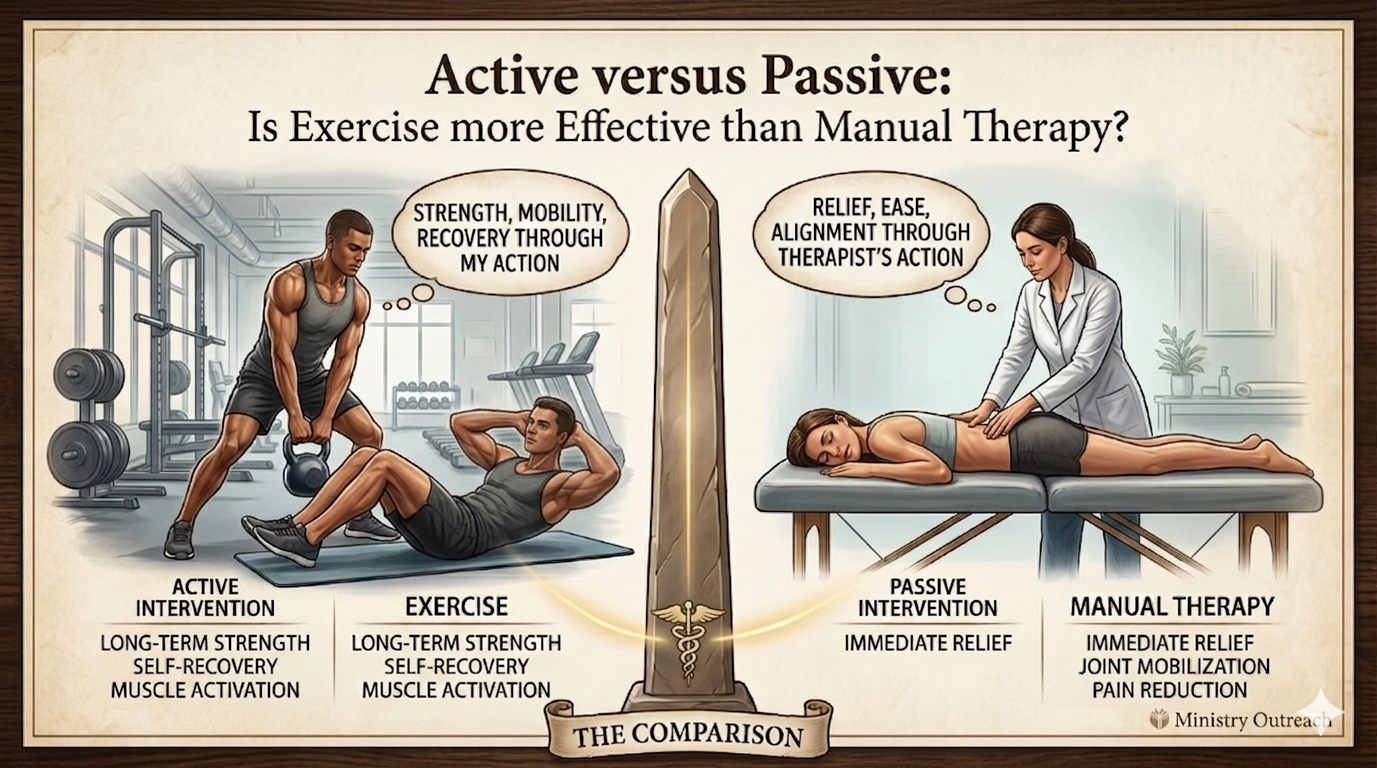
When we talk about active interventions, we mean things like therapeutic exercise, home exercise programs, and strength training — movements the person does themselves.
When we talk about passive or manual interventions, we mean things like joint mobilization¹ and joint manipulation² — hands-on techniques performed by a trained therapist or movement specialist.
The debate of "which is better" has been framed as an either/or choice. As we'll see, that framing itself is the problem.
What the Research Actually Found
A comprehensive review of randomized controlled trials³ — the gold standard of clinical research — compared manual therapy directly against exercise across multiple regions of the body. The findings were consistent and clear:
Manual therapy is generally more effective than exercise, especially in the early phases of care. Across the available research, roughly 70% of studies found manual therapy to be more effective, about 25% found both approaches equally effective, and only around 5% found exercise to be superior.
Here's what that looks like broken down by area of the body:
Neck (Cervical Spine⁴)
Multiple studies found that cervical mobilization¹ and manipulation² produced larger improvements in pain, range of motion⁵, and function than exercise alone — particularly in the first several weeks of care. Interestingly, both manual therapy and exercise outperformed medication and standard physician care for neck-related issues.⁶˒⁷˒⁸
Upper Back (Thoracic Spine⁹)
Thoracic manipulation² consistently outperformed exercise and physician care for improving neck and shoulder range of motion⁵, pain, and overall function — both in the short term and at follow-up months later.⁸˒¹⁰
Lower Back and Sacroiliac Joint¹¹
Results here are more nuanced. For lumbar manipulation², outcomes were often similar to exercise. However, lumbar mobilization¹ showed a clear advantage over exercise, particularly in the first two months of care — producing better pain reduction and functional outcomes. When specific manual techniques and exercise were combined, results were superior to general exercise alone.¹²˒¹³˒¹⁴˒¹⁵˒¹⁶
Shoulder
For individuals dealing with adhesive capsulitis¹⁷ (commonly called a frozen shoulder), shoulder mobilization¹ was more effective than supervised exercise for improving pain and range of motion⁵. The one exception was a consistent daily home exercise program, which could match manual therapy outcomes when done faithfully.¹⁸˒¹⁹˒²⁰
Elbow and Wrist (Lateral Epicondylalgia²²)
Studies on this condition — often called tennis elbow — showed that elbow mobilization¹ combined with soft tissue therapy was at least as effective as exercise, and wrist manipulation² outperformed conventional approaches including exercise, ultrasound, and friction massage for pain, grip strength, and function.²³˒²⁴˒²⁵
Hip and Knee
For hip and knee osteoarthritis²⁶ and post-injury stiffness, mobilization¹ consistently matched or outperformed exercise. In one study, success rates for hip osteoarthritis were 81% in the manual therapy group versus 50% in the exercise group — a significant difference that held through a 29-week follow-up.²⁷˒²⁸
So Should You Just Skip Exercise?
No. And this is where the real finding lives.
The research doesn't say exercise is useless — it says the framing of "active versus passive" creates a false choice that actually works against people getting better faster.
The studies that produced the best outcomes weren't the ones that chose one or the other. They were the ones that combined both. Manual therapy early in care, followed by a progressive exercise program, consistently outperformed either approach used alone.
A practical way to think about it:
Early care: More manual therapy, a small number of guided exercises, one or two things to do at home.
Mid-care: Equal parts manual therapy and exercise, building the home program.
Long-term: A solid self-managed exercise routine with occasional check-ins and manual therapy as needed.
The goal is always to move the person toward independence — but not to rush them there before the foundation is set.
Why This Matters in Our Workshops
We teach on this because people come to us in pain, confused by conflicting advice, and often frustrated that what they've been told to do on their own isn't working. Understanding the research helps them make better decisions — not just about care, but about how they think about their own bodies.
The human body was designed for movement. It was also designed with joints, tissues, and nervous system pathways²⁹ that sometimes need skilled hands to reset, mobilize, and restore — especially after injury, compensation patterns have set in, or range of motion⁵ has been lost. Exercise builds on that foundation. It doesn't always replace it.
This isn't about passive dependency. It's about using the right tool at the right time.
A Word on Sources
This article draws on a comprehensive research review developed by the Brookbush Institute as part of their Joint Mobilization and Manipulation: Introduction course. Dr. Brent Brookbush, DPT, PT, MS, CPT, HMS, IMT, compiled and analyzed the randomized controlled trials³ referenced throughout. We are grateful for that work and encourage anyone who wants to go deeper into the clinical research to explore their courses and materials directly at brookbushinstitute.com.
We don't claim to have created this science. We've walked alongside it, learned from it, and do our best to bring it to our community in a way people can actually use.
Footnotes / Reference Glossary
¹ Joint Mobilization — A hands-on technique where a trained therapist applies gentle, controlled movement to a joint to reduce stiffness, improve range of motion, and decrease pain. Movements are typically slow and within the joint's natural range.
² Joint Manipulation — A hands-on technique involving a quick, precise movement applied to a joint — often producing a "pop" sound. Used to restore normal joint movement and reduce pain. Performed by licensed professionals.
³ Randomized Controlled Trial (RCT) — The gold standard of clinical research. Participants are randomly assigned to different treatment groups, allowing researchers to compare outcomes and reduce bias.
⁴ Cervical Spine — The seven vertebrae that make up the neck region of the spine.
⁵ Range of Motion (ROM) — The full extent of movement a joint is capable of — for example, how far you can turn your head or raise your arm.
⁶ Galindez-Ibarbengoetxea et al. (2017) — Cervical manipulation showed larger immediate effects than exercise for chronic cervical pain and ROM. Alternative Therapies in Health & Medicine, 23(7).
⁷ Hoving et al. (2002, 2006) — Cervical manipulation produced better outcomes than exercise during the first 7 weeks of treatment for neck pain; both outperformed medication. Annals of Internal Medicine; Clinical Journal of Pain.
⁸ Korthals-de Bos et al. (2003) — Manual therapy (including manipulation) outperformed physical therapy and general practitioner care for neck pain in both outcomes and cost-effectiveness. BMJ, 326.
⁹ Thoracic Spine — The middle section of the spine, consisting of twelve vertebrae located between the neck and lower back.
¹⁰ Savolainen et al. (2004) — Patients with neck/shoulder pain had better outcomes at 6 and 12 months following thoracic manipulation compared to instructions for therapeutic exercise. Occupational Medicine, 54(6).
¹¹ Sacroiliac Joint (SIJ) — The joint connecting the base of the spine (sacrum) to the pelvis. A common source of low back and leg pain.
¹² Dougherty et al. (2014) — Both exercise and manipulation produced similar outcomes for chronic low back pain. Chiropractic & Manual Therapies, 22(1).
¹³ Ferreira et al. (2007) — Manipulation and specific exercise outperformed general exercise for low back pain short-term. Pain, 131(1-2).
¹⁴ Bronfort et al. (2011) — Supervised exercise outperformed home exercise; manipulation produced larger pain improvements. The Spine Journal, 11(7).
¹⁵ Krekoukias et al. (2017) — Mobilization produced larger improvements in pain and disability than conventional physiotherapy for low back pain with disk degeneration. Journal of Manual & Manipulative Therapy, 25(2).
¹⁶ Ulger et al. (2017) — SIJ mobilization produced superior pain and functional outcomes compared to stabilization exercise. Journal of Back and Musculoskeletal Rehabilitation, 30(6).
¹⁷ Adhesive Capsulitis — Commonly called "frozen shoulder." A condition where the shoulder joint capsule thickens and tightens, severely restricting movement and causing pain.
¹⁸ Yeole et al. (2017) — Mobilization with movement improved pain and ROM more than supervised exercise after one week for frozen shoulder. Indian Journal of Medical Research and Pharmaceutical Sciences, 4(2).
¹⁹ Doner et al. (2013) — Mobilization group showed larger improvements in pain, ROM, dysfunction, and patient satisfaction over passive stretching for frozen shoulder. Journal of Rehabilitation Medicine, 45(1).
²⁰ Tanaka et al. (2010) — Home exercise frequency may be more important than in-clinic mobilization frequency for frozen shoulder recovery. Clinical Rheumatology, 29(12).
²¹ Neelapala et al. (2016) — Posterolateral glide mobilization produced larger improvements in external rotator strength and shoulder pain than active strengthening alone. Journal of Musculoskeletal Research, 19(03).
²² Lateral Epicondylalgia — Commonly called "tennis elbow." Pain and tenderness on the outer side of the elbow caused by overuse of the forearm muscles and tendons.
²³ Nagrale et al. (2009) — Cyriax physiotherapy (manipulation + soft tissue therapy) outperformed phonophoresis and exercise for lateral epicondylalgia. Journal of Manual & Manipulative Therapy, 17(3).
²⁴ Joshi et al. (2013) — Wrist manipulation showed earlier and higher success rates than conventional therapy for lateral epicondylalgia. Indian Journal of Physiotherapy and Occupational Therapy, 7(3).
²⁵ Struijs et al. (2003) — Wrist manipulation group improved more than the conventional therapy group on pain and function scores. Physical Therapy, 83(7).
²⁶ Osteoarthritis — A degenerative joint condition where protective cartilage breaks down over time, causing pain, stiffness, and reduced mobility.
²⁷ Hoeksma et al. (2004) — Manual therapy produced 81% success rate vs. 50% for exercise in hip osteoarthritis. Differences held through 29-week follow-up. Arthritis Care & Research, 51(5).
²⁸ Lalit et al. (2012) — Maitland mobilizations, mobilization with movement, and exercise were equally effective for pain, proprioception, and weight-bearing in knee osteoarthritis. Indian Journal of Physiotherapy and Occupational Therapy, 6(3).
²⁹ Nervous System Pathways — The network of nerves that carry signals between the brain, spinal cord, and the rest of the body — including signals that regulate pain, movement, and muscle activation.
This article is for educational purposes and reflects current research findings. It is not intended as personal medical advice. If you are dealing with pain or movement limitations, please consult a qualified healthcare provider.