The Hip, the Pelvis, and the Connected Body
A Review of Research on Hip Function, Pelvic Stability, and Myofascial Connectivity
Pastor Kevin Cicchino
Category: Wellness Studies · Recovery And Performance
Tags: Hip Function, Pelvic Stability, Human Movement, Kinesiology, Gluteus Medius, Diaphragm, Myofascial Slings, Research, Movement Basics, Workshop Resources
Overview
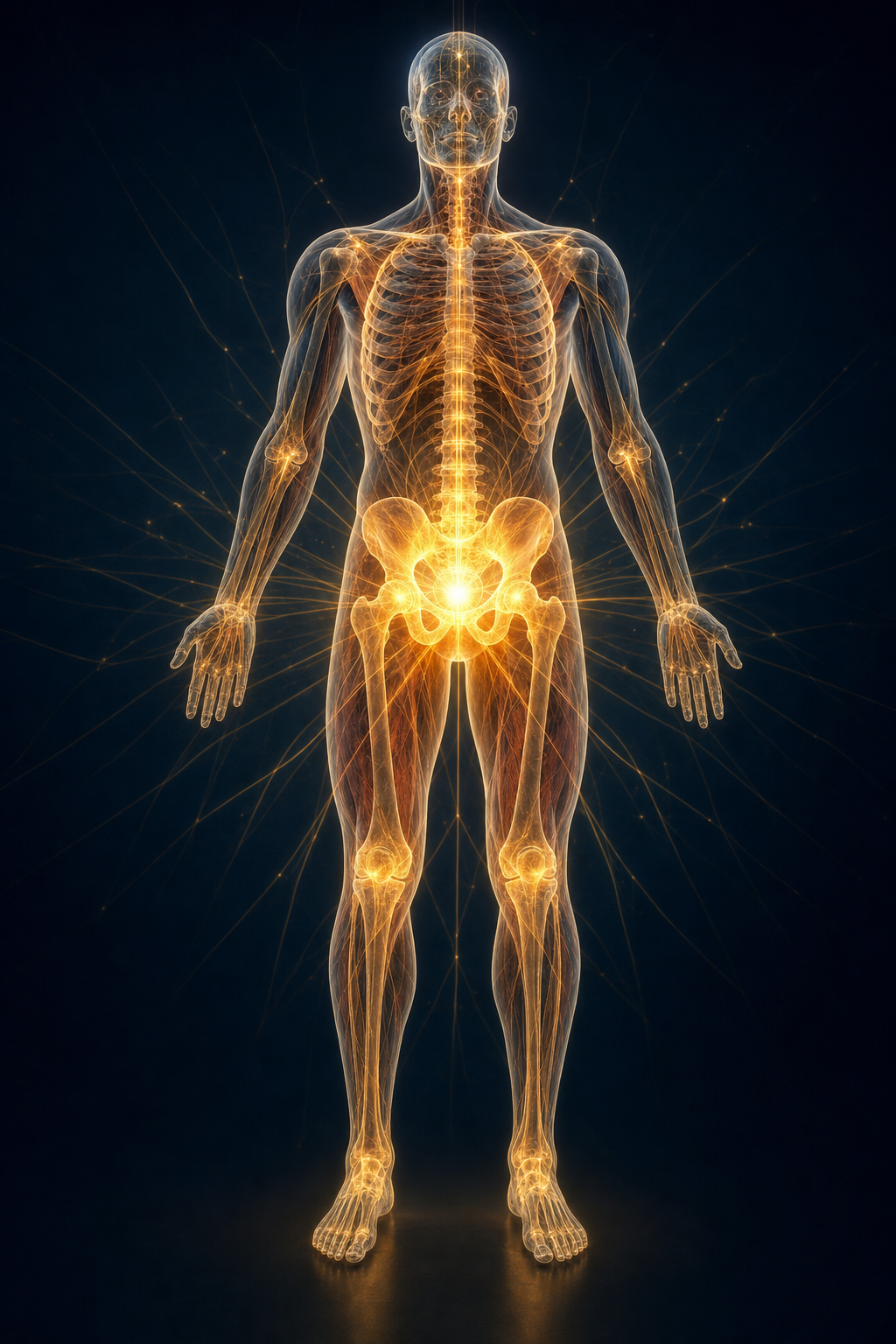
This study reviews research supporting three foundational claims about how the hip and pelvic girdle function within the broader musculoskeletal system:
The hip abductor musculature — particularly the gluteus medius — plays a primary role in pelvic stability during movement, and dysfunction in these muscles produces measurable cascade effects through the knee, IT band, lumbar spine, and lower extremity chain.
The diaphragm and pelvic floor function as a coordinated pressure system, and diaphragmatic breathing is directly connected to pelvic stability and gluteal activation during movement.
The body transmits force across segments through myofascial slings — specifically the posterior oblique system — creating a direct functional connection between the shoulder girdle and the contralateral hip that affects movement efficiency and stability throughout the body.
These three findings directly inform the teaching framework presented in our Foundation article — Your Hips Were Designed for This — and the exercise approach described in One Exercise for Uneven Hips.
Section 1 — The Gluteus Medius, Pelvic Stability, and the Kinetic Chain
The Hip as Central Pivot
Neumann (2010), writing in the Journal of Orthopaedic and Sports Physical Therapy, describes the hip joint as "a central pivot point for the body as a whole" — a large ball-and-socket joint that permits simultaneous triplanar movement of the femur relative to the pelvis, as well as movement of the trunk and pelvis relative to the femur.¹
Neumann further notes that pathology affecting the strength, control, or extensibility of the hip muscles "can significantly disrupt the fluidity, comfort, and metabolic efficiency of many routine movements" — and that abnormal hip muscle performance "may alter the distribution of forces across the joint's articular surfaces, potentially causing, or at least predisposing, degenerative changes in the articular cartilage, bone, and surrounding connective tissues."¹
This establishes a foundational principle: the hip is not a local structure. It is a system hub. What happens there distributes throughout the body.
The Gluteus Medius — Primary Pelvic Stabilizer
The gluteus medius is identified in the research literature as the primary hip abductor and a critical stabilizer of the pelvis during single-leg activities — which include every step of normal gait.
A systematic review published in the Physical Therapy Korea journal (2021) summarized findings from studies published between 2010 and 2020, concluding that the gluteus medius "plays an important role in several functional activities as a primary hip abductor by providing pelvic stabilization and controlling hip adduction and internal rotation."² The review identified gluteus medius weakness as associated with multiple disorders including "balance deficit, gait and running disorders, femoroacetabular impingement, snapping hip, gluteal tendinopathy, patellofemoral pain syndrome, osteoarthritis, and iliotibial band syndrome."²
The clinical picture that emerges from this research is consistent: when the gluteus medius is not functioning well, the pelvis loses its primary dynamic stabilizer during movement — and the body compensates through surrounding structures not designed to carry that load.
Cascade Effects Through the Kinetic Chain
The downstream effects of gluteus medius dysfunction are well-documented in the peer-reviewed literature.
A scoping review on gluteal muscle strength deficits and dynamic knee valgus found that the gluteus medius and gluteus maximus "are the key muscles contributing pelvic stability and lower extremity function" and "are frequently implicated in disorders of the knee, the pelvis, and the hip."³
Research published in PMC examining patients with patellofemoral pain syndrome found that gluteus medius dysfunction was associated with "increased hip adduction and internal rotation during weight-bearing activities" — a movement pattern that increases lateral stress through the knee and has been linked to IT band syndrome, patellofemoral pain, and anterior knee pain.⁴
A 2016 study examining the effect of gluteus medius strengthening in meniscal surgery patients found that "Gmed malfunction and decreased muscle activity cause adduction and internal rotation in hip joint during weight bearing while walking" — increasing Q-angle, causing genu valgum, and moving the patella laterally.⁵
The research consistently points in the same direction: hip abductor dysfunction at the pelvis produces measurable mechanical changes at the knee, and those changes are not resolved by treating the knee in isolation.
Going upward through the chain, Neumann (2010) notes that the alignment of the lumbar spine, pelvis, and femur are directly affected by hip muscle function — "ultimately affecting the alignment throughout the entire lower limb."¹ Clinical observations across multiple studies link gluteus medius dysfunction to a majority of non-traumatic lower back pain presentations alongside knee dysfunction.
Section 2 — The Diaphragm, Pelvic Floor, and Coordinated Pressure System
Diaphragm as More Than a Breathing Muscle
Bhagat (2024), writing in the International Journal of Advanced Research, describes the diaphragm as "the primary muscle of respiration" while noting that "in addition to its respiratory function, the diaphragm plays a crucial role in core stabilization, postural alignment, and movement control."⁶
This dual function — respiratory and postural — is the foundation of understanding why breathing matters in movement rehabilitation.
The Diaphragm-Pelvic Floor Pressure System
The pelvic floor muscles and the diaphragm function as a coordinated pressure system. Research cited in the Key Concepts literature indicates that pelvic floor muscles, including the levator ani, "contract reflexively during activities that increase intra-abdominal pressure" — and that "the pelvic floor muscles work in coordination with other core muscles, including the diaphragm and abdominal muscles, to stabilize the trunk and maintain intra-abdominal pressure."⁷
Hodges and Richardson (1997), cited in Neumann's review, demonstrated "contraction of the abdominal muscles associated with movement of the lower limb" — establishing that core and pelvic stabilization precede and accompany limb movement in well-functioning neuromuscular systems.¹
Bhagat (2024) notes that in clinical contexts where this coordination is disrupted — through sedentary lifestyles, poor breathing patterns, or compensated movement habits — the result is "posture, muscle imbalances, and joint stiffness" contributing to "low back pain, hip dysfunction, and pelvic floor disorders."⁶
Gluteal Amnesia and the Breathing Connection
Bhagat (2024) addresses the phenomenon of gluteal amnesia — the neurological inhibition of gluteal muscle activation — and its relationship to diaphragm function. The research suggests that proper diaphragm activation is foundational to restoring gluteal engagement, as the pressure system they share directly influences the neurological readiness of the gluteal musculature.⁶
This finding supports the emphasis on diaphragmatic breathing in the exercise approach described in our companion article — not as a general wellness recommendation, but as a functional prerequisite for effective hip stabilization work.
Section 3 — Myofascial Slings and the Shoulder-Hip Connection
Force Transmission Across Segments
Carey (Function First) describes myofascial slings as "the link in connecting the interdependent parts of the body" — fascial and mechanical linkages that transmit force across multiple segments and "maximize stability with mobility."⁸
The key structural principle underlying this section is tensegrity — the concept that "continuous tension is transmitted across all structures" in the fascial network, such that "an increase in tension in one of the members results in increased tension in members throughout the structure including those on the opposite side."⁸
This is not a metaphor. It is a description of how force actually moves through the body's connective tissue system.
The Posterior Oblique System
Carey identifies the posterior oblique myofascial sling as consisting of the latissimus dorsi, the contralateral gluteus maximus, and the intervening thoracodorsal fascia.⁸
This sling creates a direct functional link between the shoulder girdle and the opposite hip — meaning that tension, restriction, or dysfunction in the left shoulder affects the mechanical environment of the right hip, and vice versa.
The practical implication is significant: a person presenting with right hip instability or weakness may have a contributing factor in the left shoulder girdle — and addressing only the hip without considering the contralateral shoulder chain will produce incomplete results.
Carey also identifies the posterior longitudinal system — erector spinae, thoracodorsal fascia, sacrotuberous ligament, biceps femoris, and peroneus longus — as a sling connecting the upper back through the sacrum and into the lower leg.⁸ This chain helps explain why lumbar restriction and posterior chain dysfunction frequently co-present with hip and lower extremity issues.
Fascial Continuity as System Biology
Schleip, Findley, and Huijing's work on fascial networks — referenced across the supporting literature — establishes that the fascia "connects and supports" structures across the entire body and that "this connectivity helps in the coordination of movements, like breathing, core stabilization, and pelvic floor muscle activation."⁹
The body is not a collection of isolated parts connected by joints. It is a continuous tensional network in which every segment influences every other segment through fascial transmission.
Summary of Research Findings
The research reviewed in this study supports the following conclusions:
On hip abductor function and the kinetic chain: The gluteus medius is the primary pelvic stabilizer during movement. Its dysfunction is well-documented as a contributing factor in IT band syndrome, patellofemoral pain, knee valgus, gait dysfunction, and lumbar spine instability. Treating these downstream conditions without addressing gluteus medius function and pelvic stability produces incomplete and often temporary results.
On the diaphragm-pelvic floor pressure system: The diaphragm and pelvic floor function as a coordinated intra-abdominal pressure system. Diaphragmatic breathing directly influences pelvic stability and gluteal activation. Disrupted breathing patterns contribute to the same muscle imbalances and joint dysfunction associated with hip and pelvic instability.
On myofascial connectivity: The body transmits force through fascial slings that cross the midline and connect opposite limb segments. The posterior oblique sling directly links the latissimus dorsi to the contralateral gluteus maximus. A functionally integrated approach to hip rehabilitation must account for these cross-body connections — particularly the relationship between the shoulder girdle and the contralateral hip.
Clinical and Educational Implications
These findings support an integrated rather than isolated approach to hip function and rehabilitation. Several implications are worth naming:
Addressing pelvic instability without including diaphragmatic breathing as a functional component is likely to produce incomplete neurological engagement of the stabilizing musculature.
Addressing hip abductor weakness through isolated strengthening exercises — without restoring the neurological connection between the hip girdle, the pelvic floor, and the broader fascial system — will produce strength gains that do not reliably transfer to functional movement patterns.
The shoulder-hip fascial connection means that a comprehensive assessment of someone presenting with hip instability should include evaluation of the contralateral shoulder girdle and thoracic mobility.
Walking gait remains one of the most informative assessments of hip and pelvic function — as every step involves single-leg stance, which is the precise context in which gluteus medius function is most critically demanded.
References
¹ Neumann, D.A. (2010). Kinesiology of the Hip: A Focus on Muscular Actions. Journal of Orthopaedic and Sports Physical Therapy, 40(2), 82-94. doi:10.2519/jospt.2010.3025
² Lee, S. et al. (2021). Understanding and Exercise of Gluteus Medius Weakness: A Systematic Review. Physical Therapy Korea, 28(1), 27-37. doi:10.12674/ptk.2021.28.1.27
³ Ramskov, D. et al. (2022). The influence of gluteal muscle strength deficits on dynamic knee valgus: a scoping review. PMC. https://pmc.ncbi.nlm.nih.gov/articles/PMC9385941/
⁴ Glaviano, N. & Norte, G. (2022). Diminished central activation of the gluteus medius in females with patellofemoral pain. Frontiers in Physiology. doi:10.3389/fphys.2025.1535141
⁵ Kim, T.H. et al. (2016). The effect of gluteus medius strengthening on the knee joint function score and pain in meniscal surgery patients. Journal of Physical Therapy Science, 28(10). PMC5088119
⁶ Bhagat, A. (2024). Exploring the Importance of Diaphragm Activation, Gluteal Activation, and Their Effects on Gluteal Amnesia, Pelvic Floor Activation, Clinical Pilates for Joints Core Training and Precautions in Exercise Selection. International Journal of Advanced Research, 12(02), 633-644. doi:10.21474/IJAR01/18339
⁷ Key Concepts and Supporting Literature — Pelvic Floor Reflexes and Core Muscle Coordination. Supporting reference document.
⁸ Carey, A.B. Functional Anatomy — Myofascial Slings. Function First. CSCS, CES.
⁹ Schleip, R., Findley, T.W., & Huijing, P. (2015). Fascia: The Tensional Network of the Human Body. Elsevier.
Connected Resources
Foundation article:Your Hips Were Designed for This — Understanding How Hip Function Drives Your Whole Body
Exercise article:One Exercise for Uneven Hips — Building Stability From the Inside Out
This article is for educational and informational purposes only. The content presented here is not intended to diagnose, treat, cure, or prevent any condition or disease. Nothing in this article should be taken as medical advice. Before beginning any new movement practice, exercise program, or physical activity — particularly if you have a current or prior injury, chronic condition, or have been advised by a healthcare provider — please consult your physician or a qualified healthcare professional. The exercises and educational content shared here are general in nature and may not be appropriate for every individual. Always listen to your body and seek professional guidance when needed.