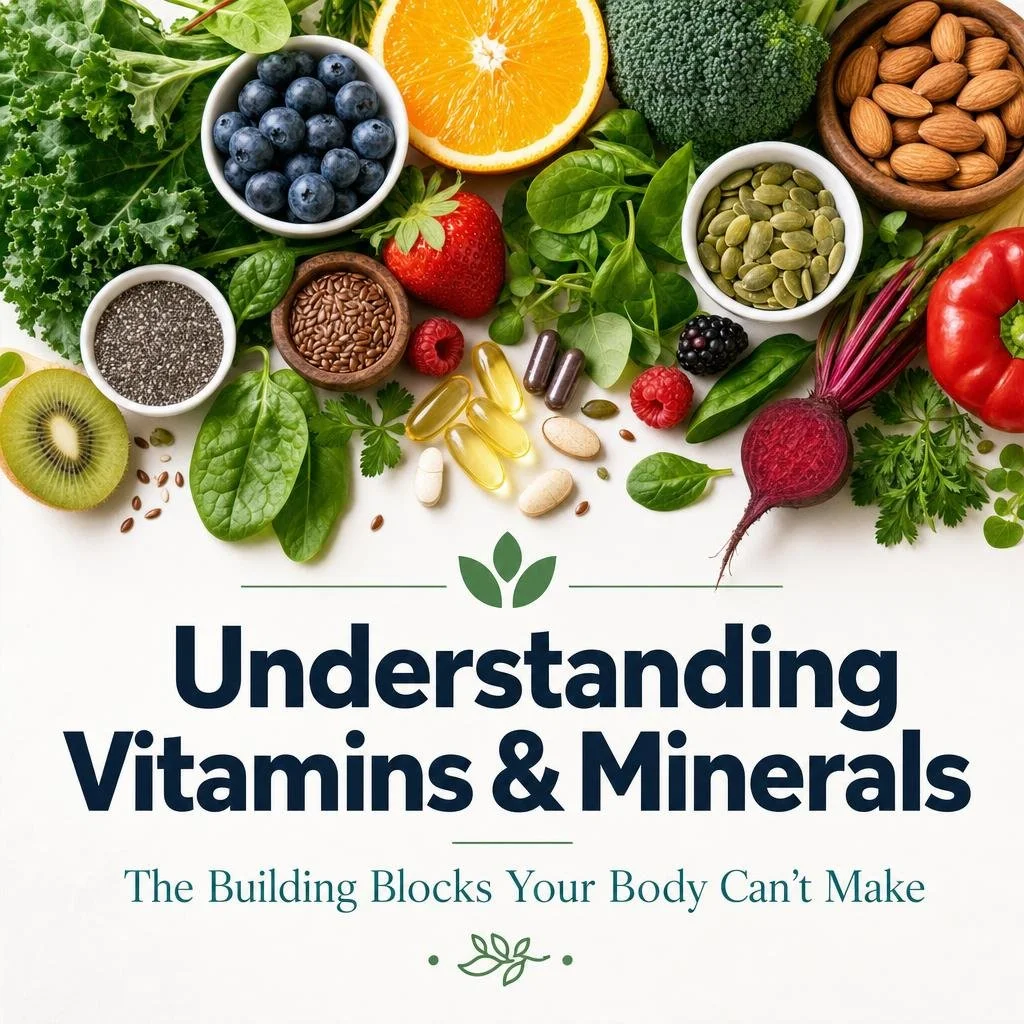
Understanding Vitamins and Minerals
The Building Blocks Your Body Can't Make
Make it stand out
Whatever it is, the way you tell your story online can make all the difference.
Pastor Kevin Cicchino
Categories: Wellness Studies, Nutrition Science, Nutrition and Health, Whole Person Wellness, Cellular Health, Wellness Foundations
Tags: Vitamins, Minerals, Nutrition, Nutritionals, Cellular Health, Wellness, Health Foundations, Nutrition, Science, Workshop Resources, Foundational Wellness
OVERVIEW
Most people know they should take vitamins. Few understand why. This study gives you a working framework — not a supplement sales pitch — for understanding how micronutrients actually function in the body and why their absence creates problems that no amount of exercise or willpower can fix.
Start today. Invest in your health.
Curious about the nutraceuticals and cellular support products we personally use and recommend? Learn more here — then come back and connect with us directly to get started. → Connect With Us
PART 1 — What Vitamins and Minerals Actually Do
Vitamins and minerals are micronutrients — meaning the body needs them in relatively small amounts, but cannot function without them.
They do not provide energy directly. Instead they make energy production possible. Think of them as the tools that allow every other system to operate:
Enzymes — most require specific minerals to activate
Hormones — many cannot be produced without specific vitamins
Immune function — directly dependent on micronutrient status
Cellular repair — requires vitamins C, E, zinc, and others
Nerve signaling — dependent on magnesium, B vitamins, and calcium
Without adequate micronutrients, the body still functions — but at a reduced capacity. Over time that reduced capacity becomes the new normal, and people stop recognizing how much better they could feel.
PART 2 — Fat-Soluble vs. Water-Soluble
This distinction matters practically.
Fat-soluble vitamins (A, D, E, K) are stored in body fat and the liver. They accumulate over time — which means both deficiency and excess are possible. They require dietary fat to be absorbed properly.
Water-soluble vitamins (C and all B vitamins) are not stored in significant amounts. The body uses what it needs and eliminates the rest. This means consistent daily intake matters far more than occasional large doses.
Minerals operate differently again — some like calcium and magnesium are needed in larger amounts (macrominerals), while others like zinc, selenium, and iron are needed in trace amounts but are equally critical.
PART 3 — The Most Common Deficiencies
Research consistently identifies the same deficiencies across populations regardless of diet quality:
Vitamin D — synthesized through sun exposure, not food. Deficiency is widespread and linked to immune dysfunction, mood disorders, bone density loss, and inflammation.
Magnesium — involved in over 300 enzymatic reactions. Depleted by stress, caffeine, and processed foods. Most people are chronically low without knowing it.
Zinc — essential for immune function, wound healing, and hormone regulation. Poor absorption is common even with adequate intake.
B12 — critical for nerve health and red blood cell production. Deficiency is particularly common in those over 50 and those avoiding animal products.
Iron — carries oxygen in the blood. Deficiency causes fatigue that is frequently misattributed to other causes.
PART 4 — The Stewardship Principle
Scripture consistently connects physical care with spiritual responsibility. The body is described as a temple — not as an afterthought, but as a framework for how we are meant to relate to physical life.
Stewardship does not mean perfection. It means intentionality. Understanding what your body requires — and making reasonable effort to supply it — is a practical expression of honoring what God has entrusted to you.
"Do you not know that your bodies are temples of the Holy Spirit?" — 1 Corinthians 6:19
This study is not prescriptive. It is a foundation for asking better questions about your own health and making informed, intentional choices.
PRACTICAL TAKEAWAYS
Get baseline blood work including Vitamin D, B12, iron, and magnesium
Prioritize food sources first — supplements fill gaps, not foundations
Fat-soluble vitamins require fat to absorb — take with meals
Consistency matters more than quantity for water-soluble vitamins
Stress and poor sleep deplete magnesium rapidly — address the source, not just the symptom
STUDY SUMMARY
Vitamins and minerals are not optional extras. They are the operating system beneath everything else your body does. Deficiency rarely announces itself dramatically — it shows up as fatigue, slow recovery, brain fog, and reduced resilience over time. Addressing the foundation changes the ceiling on everything built above it.
References — Vitamins & Minerals Study
References & Further Reading
The following references are peer-reviewed studies and institutional resources. Click any link to access the full source.
Vitamin D
Holick MF. Vitamin D Deficiency. New England Journal of Medicine. 2007;357(3):266-281. Read the study
NIH Office of Dietary Supplements — Vitamin D Fact Sheet. National Institutes of Health. View resource
Magnesium
Rosanoff A, Weaver CM, Rude RK. Suboptimal magnesium status in the United States: are the health consequences underestimated? Nutrition Reviews. 2012;70(3):153-164. Read the study
de Baaij JH, Hoenderop JG, Bindels RJ. Magnesium in man: implications for health and disease. Physiological Reviews.2015;95(1):1-46. Read the study
Zinc
Prasad AS. Zinc in human health: effect of zinc on immune cells. Molecular Medicine. 2008;14(5-6):353-357. Read the study
NIH Office of Dietary Supplements — Zinc Fact Sheet. National Institutes of Health. View resource
Vitamin B12
Allen LH. How common is vitamin B-12 deficiency? American Journal of Clinical Nutrition. 2009;89(2):693S-696S.Read the study
Iron
Camaschella C. Iron-deficiency anemia. New England Journal of Medicine. 2015;372(19):1832-1843. Read the study
General Micronutrient Reference
NIH Office of Dietary Supplements — Complete Fact Sheet Library. Comprehensive resource covering all vitamins and minerals with dosage, deficiency, and interaction data. National Institutes of Health. Browse all fact sheets
All studies accessed via PubMed (National Library of Medicine) and the NIH Office of Dietary Supplements. Links are stable institutional URLs.
The information in this study is for educational purposes. Consult a qualified healthcare provider before making changes to your supplement or nutrition protocol.